
Adversarial Datasets Help Test Hallucinations
AI hallucinations, where models generate incorrect or misleading information, pose a significant challenge in artificial intelligence development. These hallucinations occur when AI systems, especially large language models and generative AI, produce outputs that seem plausible but lack factual accuracy. To address this issue, researchers use adversarial datasets to test and evaluate AI models for their susceptibility to hallucinations. Adversarial datasets consist of carefully designed inputs that challenge AI models by introducing ambiguous, misleading, or out-of-distribution data. By analyzing AI performance on such datasets, developers can identify weaknesses, improve robustness, and enhance overall accuracy.
One of the primary ways adversarial datasets help test hallucinations is by exposing AI models to edge cases or misleading prompts. Standard training data often lacks difficult or deceptive examples, meaning AI may perform well under normal conditions but struggle when encountering unexpected inputs. Adversarial datasets deliberately introduce conflicting or challenging questions to see if the model can differentiate between fact and fiction. For example, an adversarial dataset for a language model might contain historical inaccuracies or logically inconsistent statements to test whether the AI correctly identifies errors or fabricates responses.
Another benefit of adversarial datasets is their role in stress-testing AI models across various domains. Al hallucination detection and accuracy improvement often occur when models encounter unfamiliar subjects or ambiguous queries. By incorporating adversarial datasets with diverse and complex information, researchers can evaluate how well AI generalizes knowledge and whether it maintains factual consistency. This is particularly valuable in fields like healthcare, law, and finance, where AI-generated misinformation can have serious consequences. Testing with adversarial datasets ensures that AI systems provide more reliable and accurate responses in high-stakes scenarios.
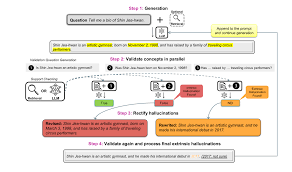
How Do Adversarial Datasets Help Test Hallucinations?
Adversarial datasets also help uncover biases that contribute to hallucinations. Many AI models inherit biases from their training data, which can lead to skewed or misleading outputs. By introducing carefully constructed adversarial samples that highlight potential biases, researchers can assess whether an AI model produces biased hallucinations. For example, a dataset may include ambiguous legal cases to determine if an AI system disproportionately favors one perspective over another. Identifying and addressing these biases helps refine AI models, making them more objective and trustworthy.
One key technique used in adversarial datasets is adversarial perturbation, where subtle modifications are made to input data to see how AI responds. In natural language processing, this might involve slight rewording of a question to test if the model changes its answer incorrectly. In image recognition, adversarial perturbations can introduce barely noticeable pixel changes to assess whether AI misclassifies an object. These methods highlight vulnerabilities in AI reasoning and decision-making, guiding improvements in model training.
Despite their effectiveness, adversarial datasets require careful design to ensure meaningful evaluation. Poorly constructed adversarial data can lead to misleading assessments, where AI models are unfairly penalized for correct reasoning. Researchers continually refine these datasets by incorporating real-world challenges, human feedback, and iterative improvements to create more reliable benchmarks for AI evaluation.
Adversarial datasets play a crucial role in testing AI hallucinations by introducing challenging, ambiguous, and misleading inputs. They help identify weaknesses, uncover biases, and improve AI robustness across different domains. By continuously refining adversarial datasets and testing AI performance against them, researchers can enhance AI reliability, ensuring that models generate more accurate, fact-based, and trustworthy responses.

Leave a Reply